

Sometimes the hardest part of a sale isn’t convincing the customer. It’s simply getting the conversation started before the moment passes.
A new lead comes in while the sales team is busy. Someone downloads a brochure but never gets a call back. A customer asks for a quote on Friday afternoon, and the follow up doesn’t happen until Monday by which point their attention has already moved somewhere else.
There’s an old saying: “Strike while the iron is hot.” In business, timing can make or break a deal.
That’s one of the biggest reasons businesses are paying closer attention to the outbound voice agent. Instead of waiting for customers to call, an AI system can proactively reach out, start a conversation, collect information, answer common questions, qualify an opportunity, schedule an appointment, and bring in a human the moment the conversation calls for one.
The goal isn’t simply to make more phone calls. It’s to make the business faster, more responsive, and more consistent in the exact moments when communication matters most.

What Is an Outbound Voice Agent?
An outbound voice agent is an AI-based voice system that initiates phone conversations with customers, prospects, leads, or other contacts on behalf of a business.
Traditional outbound calling generally depends on a person working through a contact list making the call, introducing the company, asking questions, taking notes, updating the CRM, and deciding what to do next. All of it, one call at a time.
An outbound voice AI agent automates much of this process while still holding a genuine, conversational interaction.
A real estate company could use one to contact people who previously requested information about a property. A dental clinic could follow up with patients who started an appointment request but never finished it. A home services company could reach a new lead within minutes of a quote request landing in their inbox.
The important difference is that the AI isn’t simply playing a recorded message. A modern ai voice agent responds to what the person actually says and keeps the conversation moving based on predefined business rules and information a real back and forth, not a broadcast.
Voice AI is already powering outbound sales campaigns, reminders, follow-ups, and customer re-engagement at scale. Twilio, for example, lists outbound sales calls and campaigns, automated reminders, and post-resolution customer follow-ups among its voice AI applications.
1. Faster Lead Follow-Up
A lead is most valuable the moment a business can respond while the customer’s interest is still fresh.
That sounds obvious but maintaining fast follow-up gets harder as lead volume grows. Sales reps have meetings, existing customers, administrative work, and a dozen other priorities competing for their attention. Even a strong sales team can struggle to respond to every inquiry at exactly the right moment.
An outbound voice agent changes that math entirely.
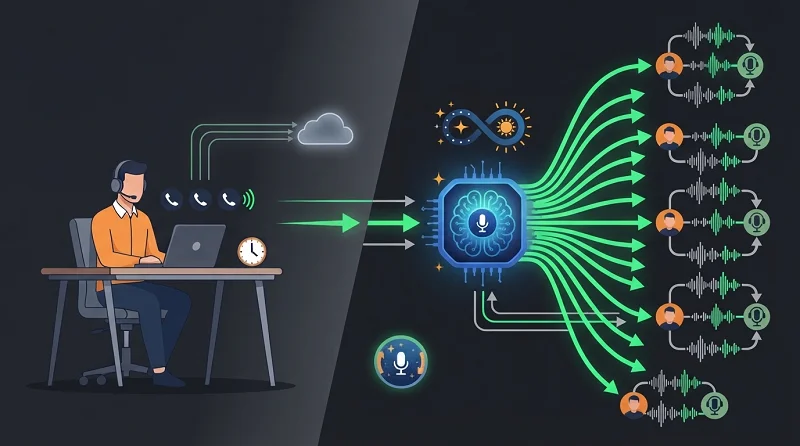
The moment a new lead enters the system, the agent can initiate a call according to the business’s rules introducing the company, confirming the reason for the inquiry, and asking a few relevant questions. The customer doesn’t have to wait for someone to notice the lead, open the CRM, dig up the phone number, and finally place the call.
That small difference can have a meaningful operational impact across an entire sales pipeline.
Twilio’s sales and support solutions specifically describe automated voice or SMS follow-ups as a way to respond to leads, schedule meetings, and deliver product information without delay.
For businesses where response speed determines whether a lead converts, an outbound voice agent effectively gives the sales process another set of hands that never gets tired or distracted.
2. Automated Lead Qualification
Not every lead is ready to talk to a salesperson.
Some are only browsing for information. Others fall outside the company’s service area. Some have an urgent need; others are still months away from making a decision.
This is where an outbound voice AI agent does far more than just place a call it does the sorting.
The agent asks the questions that actually matter to the business and uses the answers to decide what happens next. A commercial HVAC company might want to know whether a prospect needs installation, maintenance, or emergency service. A real estate company might want to understand the customer’s preferred location, property type, and purchase timeline.
Instead of routing every conversation straight to a salesperson, the AI organizes the information first so the salesperson receives a far more useful lead, with context already attached.
That doesn’t mean AI makes the final business decision. It means the repetitive first layer of qualification happens automatically, before a human specialist ever needs to get involved.
3. Appointment Booking Without the Back and Forth
Sometimes a customer is already interested. The only thing standing between interest and action is scheduling.
A customer says, “Yes, I’d like to speak with someone” and that triggers a chain of emails, texts, and missed calls just to land on a time that works for everyone.
An outbound voice agent collapses that whole process.
Connected to an appointment system or calendar, the agent can identify available times and book the appointment based on predefined rules, then confirm the details and update the relevant customer record all in the same call.
This is especially valuable for appointment driven businesses: healthcare practices, real estate companies, legal services, consultants, and home service providers all live or die by how fast they can get someone on the calendar.
The technology keeps working after the appointment is booked, too. Automated calls can remind customers of upcoming appointments, confirm attendance, or support rescheduling when plans change. Twilio documents voice-based appointment reminders and workflows for confirming, rescheduling, and updating customer records.
The benefit is simple: fewer manual steps between “I’m interested” and “It’s booked.”
4. Consistent Customer Re-Engagement
Not every opportunity closes on the first conversation.
A customer requests information and disappears. A previous customer never comes back for another service. A prospect says, “Call me next month” and next month arrives with nobody remembering to follow up.
These are exactly the moments where follow-up tends to fall apart.
An outbound voice agent turns follow-up into a structured, repeatable process instead of something that depends entirely on someone’s memory or a sticky note on a monitor.
The business defines when and why the system should reach back out. The agent initiates the conversation, understands the response, and determines whether another action is needed.
This is especially valuable for businesses with long sales cycles. Imagine a customer who requested a quote three weeks ago but never decided. Instead of letting that opportunity quietly disappear into the CRM, an AI agent can reconnect, ask whether the requirement is still active, and if it is arrange a conversation with the sales team.
The objective isn’t to badger people with repeated calls.
It’s to make sure legitimate opportunities don’t vanish simply because nobody had time to follow up.
5. Less Repetitive Work for Human Teams
One of the strongest business cases for an ai voice agent isn’t replacing human employees it’s removing the repetitive work that eats up their day.
Think about a sales rep’s actual schedule. A significant chunk of it involves dialing numbers, introducing the company, confirming basic information, asking the same qualification questions over and over, leaving voicemails, scheduling appointments, and updating records.
All of that is important. Almost none of it requires the judgment of an experienced salesperson.
An outbound voice agent absorbs that repeatable layer, freeing employees to focus on the conversations that genuinely need expertise, negotiation, and relationship building.
This is where AI stops being a novelty and starts becoming an operational tool.
The simplest way to think about it: let AI handle repetition, and let people handle judgment.
Modern voice AI platforms are built around exactly this kind of human handoff. Twilio describes voice agents that collect context and information before routing more complex issues to a human agent the AI does the groundwork, the person closes the deal.
That balance matters. A good system should know precisely when it can keep going on its own and when it’s time to bring a person in.
6. Better CRM Integration and Business Visibility
A phone call shouldn’t exist as an isolated event.
If an agent talks to a customer but the information never makes it into the CRM, most of the value of that conversation evaporates.
This is exactly why integration is one of the most important factors when choosing an ai voice agent agency or technology provider.
A properly connected system records the outcome of every call, updates customer information, captures qualification details, schedules appointments, and triggers the next stage of the workflow automatically.
The result is a genuinely connected customer journey. A lead comes in through a website form. The outbound voice agent calls the prospect. The customer explains what they need. The system records the information, marks the lead as qualified, schedules an appointment, and hands the sales rep full context before they ever pick up the phone.
Nobody has to manually copy notes from a notebook into the CRM.
Twilio’s voice documentation also describes programmatic outbound calling with tools for tracking call outcomes and capturing call information proof that voice interactions can become part of a measurable workflow rather than a standalone, forgettable phone call.
Outbound Voice Agent vs. Inbound Voice Agent
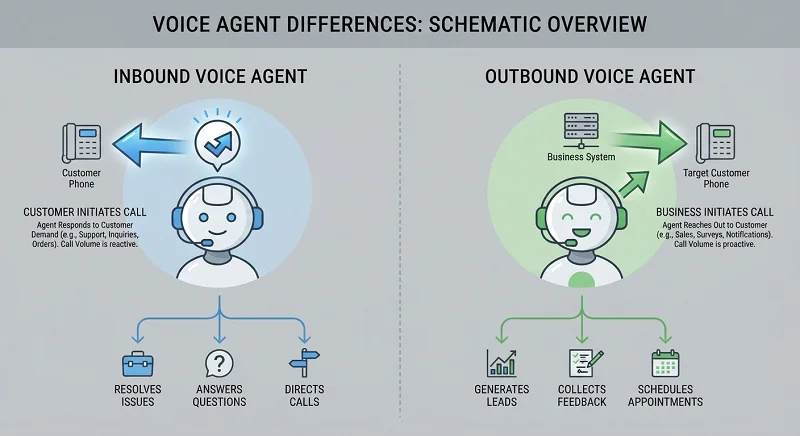
The difference between an outbound voice agent and an inbound voice agent comes down to one question: who starts the conversation.
An inbound voice agent waits for the customer to call. It answers questions, collects information, books appointments, routes calls, and provides support.
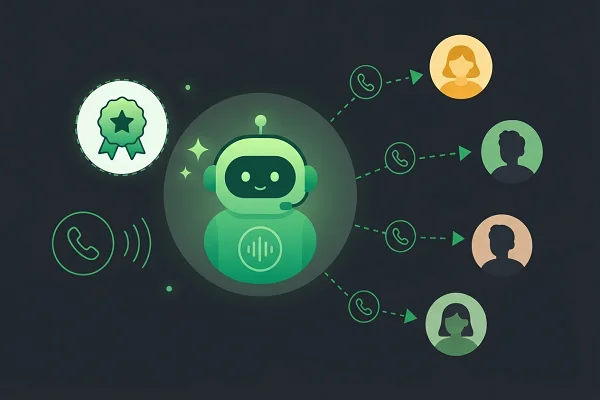
An outbound voice agent takes the initiative it calls the customer or prospect first.
Picture a dental practice. When a patient calls to book an appointment, an inbound voice agent answers and helps them schedule it. But if the practice wants to reach patients who started an appointment request and never finished it, an outbound voice agent is what makes that follow-up happen.
The two technologies are complementary, not competing.
Inbound voice AI responds to demand. Outbound voice AI creates an opportunity to act on demand that already exists.
For businesses with significant customer communication volume, combining both builds a genuinely complete voice automation strategy one that never leaves a gap on either side of the phone.
For more information, read benefits of Inbound Voice Agent article.
Choosing the Right AI Voice Agent Companies
Plenty of ai voice agent companies are entering the market right now, but the technology itself shouldn’t be the deciding factor.
The real question is whether the agent actually fits the business.
A good solution understands the company’s services, target customers, qualification criteria, escalation rules, and desired outcomes and it connects cleanly with the systems the business already relies on.
A restaurant, a dental clinic, a real estate company, and a B2B software company shouldn’t all be handed the same voice agent. The conversation needs to reflect the business behind it.
The best implementations start with the workflow, not the technology: What happens when a lead arrives? What questions need asking? When should a human take over? Where should the information go? What happens after the call ends?
Once those questions are answered clearly, the technology itself becomes the easy part.
How Zaptron Approaches AI Voice Agents
This is where Zaptron AI comes into the picture.
Zaptron builds AI voice agents and business automation solutions designed around specific business workflows, rather than treating voice AI as a one-size-fits-all product.
For an outbound campaign, that means designing an agent around the company’s actual lead qualification process, connecting it with CRM and scheduling tools, defining exactly when conversations should transfer to a human, and determining what information gets captured after every single call.
The goal isn’t simply to give a business an AI voice.
The goal is to build a system that can listen, understand, act, and move the customer journey forward — every time, not just on the calls that go smoothly.
That distinction matters more than it sounds. A business doesn’t need thousands of automated conversations for the sake of automation. It needs useful conversations that produce useful outcomes.
A Note on Trust and Compliance
Outbound calling also has to be handled responsibly.
AI makes it easier to contact large numbers of people but that doesn’t mean every number should be called. Consent, disclosure, calling rules, and local regulations all need to be factored in before deploying an automated calling campaign.
In the United States, the FCC stated in 2024 that AI-generated voices fall under the Telephone Consumer Protection Act’s restrictions on artificial or prerecorded voice calls. The ruling made clear that AI voice cloning doesn’t create a separate exemption from existing consumer protection rules.
For businesses, that’s an important reminder: successful voice automation isn’t only about what the technology can do. It’s also about how responsibly it’s implemented.
The Real Value of an Outbound Voice Agent
The most interesting thing about an outbound voice agent isn’t that it can make a phone call.
Businesses have been making automated calls for years.
The real change is that AI can now participate in a conversation, understand a response, and connect that conversation directly to the next business action.
A lead arrives. The agent calls. The customer explains what they need. The system qualifies the opportunity, schedules a meeting, updates the CRM, and brings a human into the loop exactly when necessary.
That’s a much bigger idea than “automated calling.”
It’s business communication becoming part of an automated workflow.
For companies dealing with large volumes of leads, repetitive follow-ups, or appointment-based sales processes, that translates into less administrative work, faster responses, and more time for people to focus on the conversations where human expertise genuinely matters.
FAQ about Outbound Voice Agent
1-What is an outbound voice agent?
An outbound voice agent is an AI system that initiates phone conversations with leads or customers. It can conduct conversations, collect information, qualify prospects, schedule appointments, and trigger follow-up actions.
2-What can an outbound voice AI agent actually do?
It can handle tasks such as lead follow-up, qualification, appointment booking, reminders, customer re-engagement, and information collection, depending on how the system is configured.
3-Can an outbound voice agent make cold calls?
Technically, voice AI can be used for outbound campaigns, but businesses need to consider consent, telemarketing regulations, and local calling requirements before using it for unsolicited outreach.
4-What is the difference between an inbound voice agent and an outbound voice agent?
An inbound voice agent responds to calls initiated by customers. An outbound voice agent initiates the call itself, usually to follow up with a lead, customer, or prospect.
5-Can an AI voice agent transfer the call to a human?
Yes. A well-designed system can identify situations that require human assistance and transfer the conversation along with relevant context.
6-Can an outbound voice agent update a CRM?
Yes. When integrated with a CRM, the system can record call outcomes, collect customer information, update lead records, and trigger subsequent workflows.
7-How much does an outbound voice agent cost?
Pricing depends on factors such as call volume, integrations, conversation complexity, voice infrastructure, and the level of customization. There is no single price that applies to every business.
8-Are AI voice agents suitable for small businesses?
They can be particularly when a small team receives more calls or leads than it can consistently follow up with. The key is choosing a use case where automation solves a genuine operational problem rather than adding unnecessary complexity.