

A phone rings.
On the other end, there may be a customer looking for an answer, a new lead ready to ask a question, or an existing customer who simply needs help. For a business, that call can be routine or it can be a valuable opportunity, depending entirely on how fast and how well it’s handled.
The problem is that businesses never know exactly when the next call will land.
During busy hours, calls pile up. Employees are already on the phone. Some callers wait. Others hang up, call a competitor, or just move on. And by the time the business finally responds, the opportunity may already be gone.
This is where an inbound voice agent can change the way businesses handle phone communication.
Instead of relying entirely on employees to answer every incoming call, businesses can use an AI voice agent to understand callers, answer questions, collect information, complete routine tasks, and route conversations to the right person when human assistance is genuinely needed.
The result isn’t simply an automated phone system. It’s a more responsive way to manage customer conversations at any hour, at any volume.
What Is an Inbound Voice Agent?
An inbound voice agent is an AI-based voice system built to handle incoming phone calls from customers, prospects, patients, or other callers.
Unlike a traditional IVR system that makes callers select from a menu, an AI voice agent understands natural language and responds conversationally.
Instead of:
“Press 1 for sales. Press 2 for support. Press 3 for billing.”
A caller can simply say:
“I want to know if you offer same day appointments.”
The inbound voice AI agent identifies the intent behind that request, retrieves the relevant information, and responds according to the business’s workflow no menu maze required.
Depending on its configuration, an ai voice agent can also:
- Answer frequently asked questions
- Qualify incoming leads
- Book appointments
- Collect customer information
- Route calls to the appropriate department
- Check order or service information
Twilio describes an inbound call as a call initiated by a customer to a business or contact center, and its Voice AI documentation frames modern AI voice agents as systems capable of understanding conversations, taking action in connected systems, and handing the conversation to a human when necessary.
That distinction matters.
An inbound voice agent isn’t there just to “answer the phone.” Its real value shows up in what it does after answering.
What Is an Outbound Voice Agent?
An outbound voice agent works in the opposite direction.
Instead of waiting for customers to call, the business or its systems initiates the call.
An outbound voice agent could reach out to:
- New leads
- Existing customers
- Appointment holders
- Prospects who requested information
- Customers due for a follow-up
- People who need reminders or notifications
Picture a customer submitting a quote request on a website. An outbound voice agent could automatically call them, confirm the request, collect additional information, answer basic questions, and schedule the next step often before the lead has even opened their inbox.
Twilio defines outbound calls as calls initiated by a business or its systems toward an external phone number, and shows outbound voice automation being used for gathering information, sending notifications, and connecting call outcomes back into business systems.
So while inbound and outbound voice agents run on similar underlying technology, they solve fundamentally different communication problems.
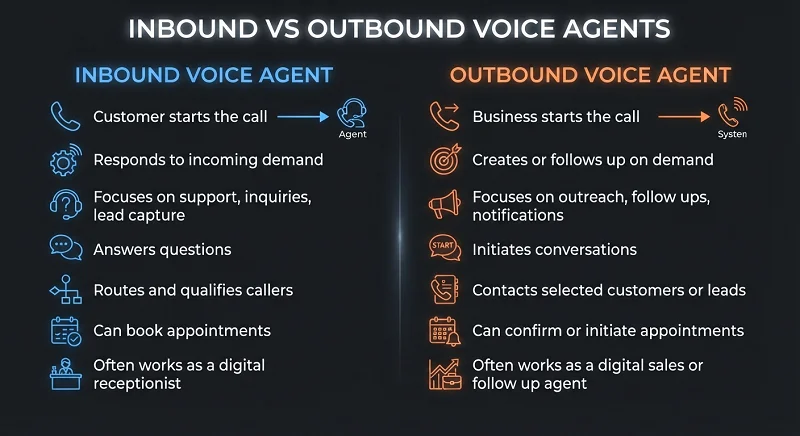
Inbound vs. Outbound Voice Agents: What’s the Difference?
The simplest way to tell them apart is to ask one question: Who starts the conversation?
In practice, most businesses don’t have to pick just one.
An inbound voice agent can handle incoming calls while an outbound voice agent follows up with leads or customers on the other side.
That’s a connected customer journey not two disconnected phone systems bolted together.
How AI Voice Agents Handle Calls
Modern AI voice agents combine speech recognition, conversational AI, business logic, and voice generation to manage a conversation in real time. Here’s what that actually looks like, step by step.
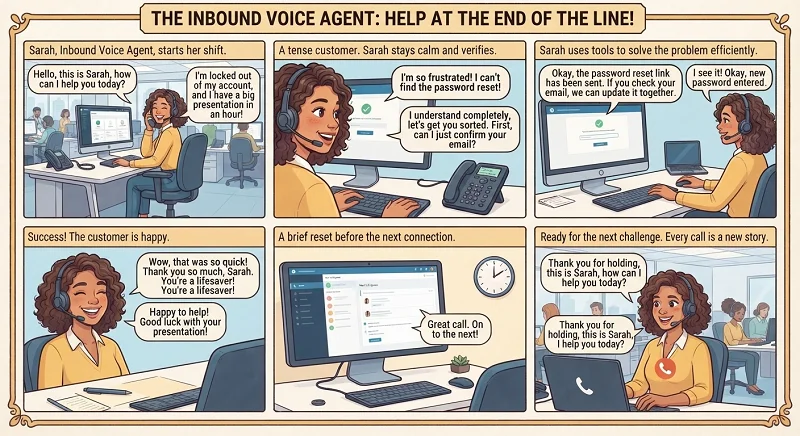
1. The Call Comes In
A customer dials the business phone number. The inbound voice agent answers and introduces itself in the company’s preferred tone and style.
2. The Agent Understands the Caller
The caller speaks naturally instead of navigating a menu. The AI identifies the intent behind the conversation.
For example:
“I need to change my appointment from Tuesday to Thursday.”
The caller doesn’t need to know which department handles appointment changes the system figures that out and follows the right workflow automatically.
3. The Agent Takes Action
This is where an AI voice agent pulls ahead of a traditional phone menu.
Depending on its integrations, the agent can interact with business systems to:
- Check information
- Create a booking
- Update a record
- Capture a lead
- Trigger a workflow
- Send information
- Transfer the conversation
Twilio describes modern Voice AI as moving beyond simple responses toward completing full workflows and taking action inside connected systems.
4. The Agent Escalates When Necessary
Not every conversation should be automated and a good inbound voice AI agent knows exactly where that line is.
When a request falls outside its defined capabilities, the conversation gets transferred to a human employee. This matters most for sensitive, complex, high value, or unusual requests, where getting it wrong costs more than a few minutes of delay.
5. The Conversation Becomes Business Data
Every voice interaction can also generate useful operational information. Depending on the system, businesses can capture:
- Caller intent
- Contact information
- Conversation outcomes
- Appointment details
- Lead information
That data flows straight into CRM and other business workflows, turning a phone call into structured, usable information instead of a note scribbled on a sticky pad.
What Can an Inbound Voice Agent Actually Do for a Business?
The applications of an inbound voice agent go well beyond answering basic questions.
Lead Qualification
Not every incoming call is the same opportunity.
An AI voice agent can ask predefined questions, understand what the caller actually needs, and collect the information sales teams rely on. Instead of a note that just says “someone called about our service,” the business gets structured information about what the caller wants and what should happen next.
Customer Support
Many support calls have predictable answers.
An AI voice agent can handle the common ones directly and route the more complex cases to a human support representative so nobody waits in line for a question the system already knows the answer to.
Appointment Booking
Appointment-driven businesses can use inbound voice agents to let customers schedule, reschedule, or cancel no back and forth required. This is especially useful for healthcare, dental clinics, salons, professional services, home services, and other appointment-based businesses.
Call Routing
Callers don’t always know which department they need.
An AI agent can understand the reason for the call and route it appropriately, cutting down unnecessary transfers and making the whole phone experience feel less like a maze.
After Hours Communication
Customers don’t only call during business hours.
An inbound voice agent can provide information and handle eligible workflows outside normal operating hours, keeping the business responsive without requiring anyone to stay glued to the phone.
Inbound Voice AI Agent vs. Traditional IVR
Traditional IVR systems have done their job for decades. The problem is that most of them force the customer to adapt to the system, instead of the system adapting to the customer.
“Press 1.” “Press 2.” “Press 3.” Pick the wrong option, and the whole process starts over.
An inbound voice AI agent flips that script: the caller explains what they need in plain language, and the AI figures out the right workflow from there.
Twilio frames this as the difference between menu driven IVR and intent driven Voice AI modern Voice AI can understand natural language, handle ambiguity, and complete workflows instead of just presenting a list of options.
That doesn’t make IVR obsolete. For some businesses, traditional IVR is still the right fit. The better approach comes down to how complex the customer journey is and what the system actually needs to do.
How AI Voice Agent Companies Build Inbound Voice Systems
The quality of an inbound voice AI agent depends on far more than how natural the voice sounds.
A successful implementation usually requires several pieces working together.
That’s why businesses evaluating ai voice agent companies should look past the demo. A slick demo is nice, but the real question is:
Can the agent actually complete the business workflow?
An agent that answers “What are your opening hours?” is useful. An agent that understands why a customer is calling, pulls the relevant system, completes the right action, logs the result, and escalates when necessary that’s a real business automation solution.
Choosing an AI Voice Agent Agency
Businesses that don’t want to build everything in-house often work with an ai voice agent agency. A few things are worth checking before you commit to one.
Business Workflow Understanding
The agency should understand your actual business process before it designs anything.
Integration Capabilities
The AI agent needs to work with the systems you already use CRM, calendars, help desks, booking platforms, internal databases not force you onto new ones.
Human Handoff
There should be a clear, well-defined process for transferring a conversation the moment AI isn’t the right answer.
Conversation Design
A voice agent needs more than a script. It needs conversation flows built for interruptions, vague answers, unexpected requests, and every intent a real caller might throw at it.
Reporting and Optimization
You should be able to see what actually happens on calls and use that visibility to keep improving the workflows over time.
This is the approach Zaptron takes with AI automation: the voice agent is treated as part of a broader business workflow, not an isolated phone-answering gadget.
Should Your Business Use Inbound or Outbound Voice AI?
It depends on what you’re actually trying to solve.
If your biggest challenge is handling incoming demand, an inbound voice agent is the natural starting point.
If your challenge is following up with leads, customers, or scheduled contacts, an outbound voice agent is likely more relevant.
And if both problems exist which is common the two work together.
Inbound captures the conversation that comes to you. Outbound starts the conversation you need to have.
Together, they build a continuous voice communication layer across the entire customer journey.
FAQ about Inbound Voice Agent
1- What is an inbound voice agent?
An inbound voice agent is an AI system designed to answer incoming phone calls, understand what callers need, provide information, complete predefined tasks, and transfer conversations to human employees when necessary.
2-What is the difference between an inbound voice agent and an outbound voice agent?
An inbound voice agent handles calls initiated by customers or other external callers. An outbound voice agent initiates calls to customers, prospects, or other contacts on behalf of a business.
3-Can an inbound voice agent book appointments?
Yes. When connected to a compatible scheduling or booking system, an inbound voice agent can help callers schedule, reschedule, or cancel appointments according to predefined business rules.
4-Can an inbound voice AI agent qualify leads?
Yes. An inbound voice AI agent can ask qualifying questions, collect contact information and requirements, and pass structured lead information to a CRM or sales team.
5-Can an AI voice agent transfer a call to a human?
Yes. A properly designed AI voice agent can transfer calls when a request requires human assistance or falls outside the agent’s defined workflow, and modern voice AI systems can pass along relevant conversation context during that handoff.
6-Is an inbound voice agent the same as an IVR?
No. A traditional IVR generally guides callers through predefined menus and keypad selections. An AI voice agent understands natural language and determines the caller’s intent, making the interaction feel like a real conversation.
7-What industries can use inbound voice agents?
Inbound voice agents work across many industries, including healthcare, real estate, home services, professional services, hospitality, e-commerce, financial services, and customer support.
8-How much does an inbound voice agent cost?
Pricing depends on call volume, integrations, workflow complexity, customization, AI model usage, and the level of human escalation required. Evaluate the complete workflow and its operational value — not just the cost per minute.
Conclusion
An inbound voice agent is more than an automated phone receptionist.
Properly designed, it becomes a digital communication layer that listens to customers, understands their intent, answers questions, completes routine tasks, captures information, and connects people with the right human exactly when it matters.
The distinction between inbound and outbound comes down to this: inbound voice AI responds to conversations that come to the business, while outbound voice AI creates the conversations the business needs to initiate.
For companies exploring ai voice agent companies, an ai voice agent agency, or a broader voice automation strategy, the real question isn’t whether AI can talk.
It’s whether AI can understand, act, integrate, and know when to hand the conversation back to a human.
That’s where voice AI becomes business automation and that’s the opportunity Zaptron is built to help businesses explore.