

In healthcare, a phone call is rarely just a phone call.
A patient may be calling to book an appointment, ask about available services, confirm a visit, request information, or simply figure out where to go next. Every one of these calls needs time, attention, and a reliable response and when the phone won’t stop ringing, even the best reception team can get buried.
This is where an AI voice agent for healthcare can make a real difference. Instead of treating AI as a replacement for the human team, healthcare organizations can use voice AI to absorb repetitive communication, organize incoming requests, and make sure patients get a timely response, any time they call.
The goal isn’t to put technology between patients and their providers. It’s to strip away the friction that gets in the way of that relationship.

What Is an AI Voice Agent for Healthcare?
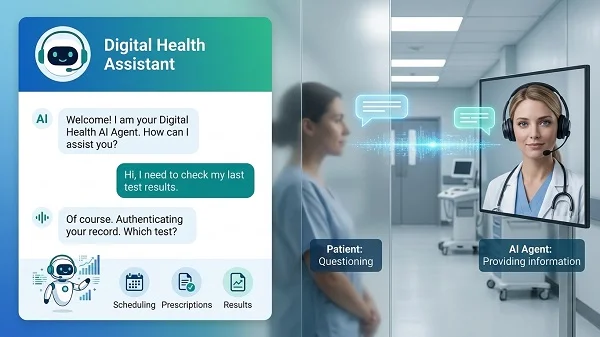
An AI voice agent for healthcare is an AI based system that talks with patients through natural voice conversation. Unlike a traditional phone tree that makes callers “press 1 for billing, press 2 for scheduling,” it understands spoken requests and responds conversationally the way a person would.
For example, a patient might simply say:
“I need to schedule an appointment for next week.”
The system identifies the request, matches it to the relevant service, checks available options when connected to a scheduling platform, and walks the caller through the next step no menu, no hold music.
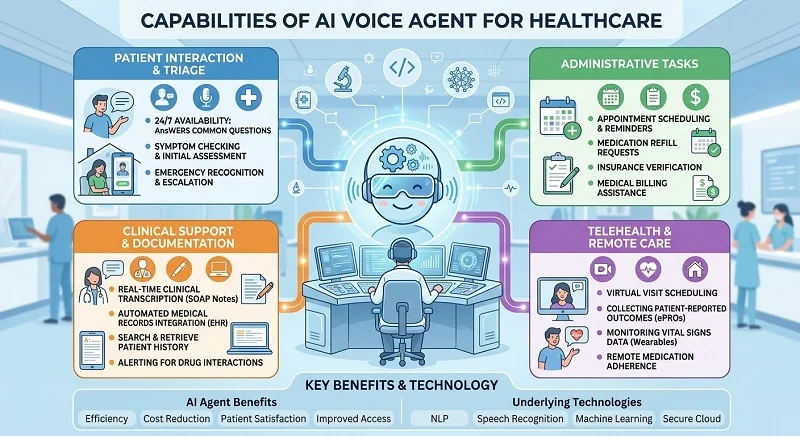
Depending on how it’s configured, this kind of assistant can also answer common questions, collect basic information, route calls, confirm appointments, send reminders, and hand the caller off to staff whenever human judgment is required.
That last point matters. A healthcare voice agent should be built around clearly defined workflows and boundaries. It’s not a substitute for a physician, nurse, or other clinical professional and it shouldn’t try to be.
How AI Voice Agents Work in Healthcare
The process typically starts the moment a patient calls in.
The system listens, identifies the intent behind the call, and follows a predefined workflow, then retrieves or collects whatever information that workflow requires.
A typical interaction might include:
- Understanding why the patient is calling
- Identifying the right department or service
- Answering frequently asked questions
- Collecting basic patient information
- Scheduling or rescheduling appointments
- Confirming appointment details
- Sending follow-up information
- Transferring complex requests to a human staff member
- Syncing the conversation with a CRM or other business system
This makes voice AI particularly valuable for organizations fielding a high volume of repetitive calls, the system handles the predictable part of the conversation, while the healthcare team stays free for the situations that actually need a human.
Where Healthcare Businesses Are Putting It to Work
Healthcare organizations run a lot of communication processes that follow predictable patterns, which makes them well suited to carefully designed voice automation.
Appointment Scheduling
This is the clearest, highest impact use case.
Patients call to check availability, book an appointment, reschedule, or cancel a visit. Connected to the right scheduling system, the AI agent can automate all of it, reducing repetitive work for reception staff and making appointment booking available well beyond office hours.
Appointment Reminders and Confirmations
Missed appointments create real operational costs.
An AI voice agent can proactively reach out with reminders, confirmations, or pre-visit instructions. Healthcare communication still has to respect appropriate privacy safeguards here, the U.S. Department of Health and Human Services confirms that providers may communicate with patients about their care, including appointment reminders, as long as the right safeguards are in place.
Answering Common Patient Questions
Most healthcare calls aren’t complex medical decisions, they’re logistics. Patients want to know:
- What services does the clinic provide?
- What are the office hours?
- Where is the office located?
- What should I bring to my appointment?
- How do I reschedule?
- Which department should I talk to?
A voice agent can answer these routine questions consistently, every time, freeing staff to focus on the conversations that need more attention.
Call Routing and Patient Intake
Larger clinics and healthcare systems field calls for multiple departments at once.
An AI voice agent can figure out the reason for the call, route it to the right team, and collect basic information before the transfer, creating a smoother handoff and giving staff more context the moment they pick up.
Follow-Up Communication
Voice AI also supports structured follow-up: checking in after an appointment, reminding patients about a scheduled service, or communicating administrative instructions.
When these interactions follow predefined rules, automation makes the whole process more consistent and easier to manage at scale.
What Healthcare Organizations Actually Gain
The value here isn’t just “a machine can answer the phone.” It’s a more organized communication system, end to end.

24/7 Patient Communication
Most healthcare organizations don’t run a 24-hour front desk, but patients still call outside business hours. An AI voice agent can provide information and handle eligible workflows even when reception staff have gone home.
Less Administrative Load
Reception teams spend a disproportionate amount of time on repetitive questions and routine requests. Automating that layer frees employees to spend more time with patients and on work that genuinely needs a human.
Faster Response Times
Patients don’t always want to wait for someone to become available. A conversational AI system responds immediately to routine requests and gets callers to their next step without a long phone menu in the way
.
Consistency, Even During Peak Hours
Human teams get busy, especially at peak times, when call quality can slip. A voice agent follows the same approved workflow every time, which helps healthcare businesses keep routine communication consistent no matter how many calls come in at once.
Data Privacy Is Non Negotiable in Healthcare
Healthcare is different from most other industries because voice interactions routinely involve sensitive patient information.
That means choosing a voice AI system for healthcare takes more than evaluating voice quality or automation features. Organizations need to understand exactly what information the system collects, where it’s stored, who can access it, and which third-party services are involved.
For U.S. organizations subject to HIPAA, this becomes especially important whenever a technology provider creates, receives, maintains, or transmits protected health information (PHI) on the organization’s behalf. HHS explains that vendors performing certain functions involving PHI may qualify as business associates, which means appropriate contractual safeguards, including a Business Associate Agreement where required, become relevant.
Before deploying any voice AI system, healthcare organizations should evaluate privacy, security, data handling, access controls, integrations, and compliance requirements, not as an afterthought, but as a first filter.
How to Choose the Right AI Voice Agent for Healthcare
There’s no single system that’s automatically the best fit for every organization. The right choice depends on your workflow, your patient communication needs, your existing tech stack, and your compliance requirements.
Before selecting a solution, healthcare businesses should look at:
- Natural, genuinely understandable voice conversations
- Appointment scheduling capabilities
- CRM and system integrations
- Call routing and escalation logic
- Data privacy and security controls
- HIPAA-related safeguards where applicable
- Conversation logging and reporting
- Custom workflow configuration
- Human handoff capabilities
- Scalability across departments and locations
A good healthcare voice agent should fit into your existing operational system, not force you to redesign your workflow around it.
Voice AI Automation, Done Right
Interest in AI voice agent companies has grown fast, and that reflects a broader shift toward conversational automation. But healthcare demands a more careful approach than simply bolting on a chatbot or an automated phone system.
The strongest implementations start with the business process, not the technology: What types of calls come in? Which requests are repetitive? Which conversations genuinely need a human? What systems need to connect? What information can safely be collected through an automated workflow?
Zaptron approaches AI automation from exactly this angle, combining conversational AI with workflow automation and business system integration. For healthcare organizations, that means designing voice workflows around real operational needs, not treating a voice agent as a standalone gadget bolted onto the front desk.
Where This Is Headed
The future of healthcare communication won’t be entirely human or entirely automated, it’ll be both, working together.
AI can handle repetitive conversations, appointment workflows, basic information requests, and structured follow-ups. That frees healthcare professionals and administrative teams to spend their time where human judgment, empathy, and expertise actually matter.
A good tool doesn’t replace the craftsman, it helps the craftsman work better. That’s the right lens for thinking about voice AI in healthcare: the goal isn’t to make patient care less human. It’s to clear away the repetitive work that keeps healthcare teams from being more human where it counts.
for more information, you can also read the “AI Voice Agent Services for Businesses“
Frequently Asked Questions
1-What is an AI voice agent for healthcare?
It’s a conversational AI system that communicates with patients through voice calls. Depending on its configuration, it can answer common questions, schedule appointments, collect information, route calls, send reminders, and transfer conversations to healthcare staff.
2-Can an AI voice agent schedule healthcare appointments?
Yes. Connected to an appropriate scheduling system, it can help patients book, reschedule, or cancel appointments according to predefined workflows.
3-Can AI voice agents replace healthcare receptionists?
They’re better understood as a support and automation layer, not a full replacement. They handle repetitive communication while human staff manage complex, sensitive, or exceptional situations.
4-Are AI voice agents HIPAA compliant?
Compliance depends on how the technology is configured, what information it handles, and the responsibilities of the organizations involved. Healthcare businesses should evaluate a vendor’s data practices, security controls, contractual arrangements, and applicable HIPAA requirements before deployment.
5-Can an AI voice agent for healthcare answer medical questions?
It can provide approved general information within a defined workflow, but clear boundaries around clinical advice are essential. Questions requiring diagnosis, treatment decisions, or professional medical judgment should always be escalated to qualified healthcare professionals.
6-How much does an AI voice agent for healthcare cost?
Pricing depends on call volume, workflow complexity, integrations, customization, data requirements, and the level of automation involved. Evaluate the full implementation, not just the sticker price of the voice agent itself.
Conclusion
An AI voice agent for healthcare can turn routine phone communication into a structured, automated workflow appointment scheduling, reminders, patient intake, call routing, and FAQs, all handled consistently while administrative load drops.
The real differentiator is implementation. The right system understands your organization’s workflow, integrates with the tools you already use, protects sensitive information, and knows exactly when a conversation needs to move from AI to a human.
If you’re exploring AI voice agent companies, comparing AI voice agent for healthcare, or trying to find the best fit for your organization, don’t start with the technology.
Start with the patient journey.



2 Responses